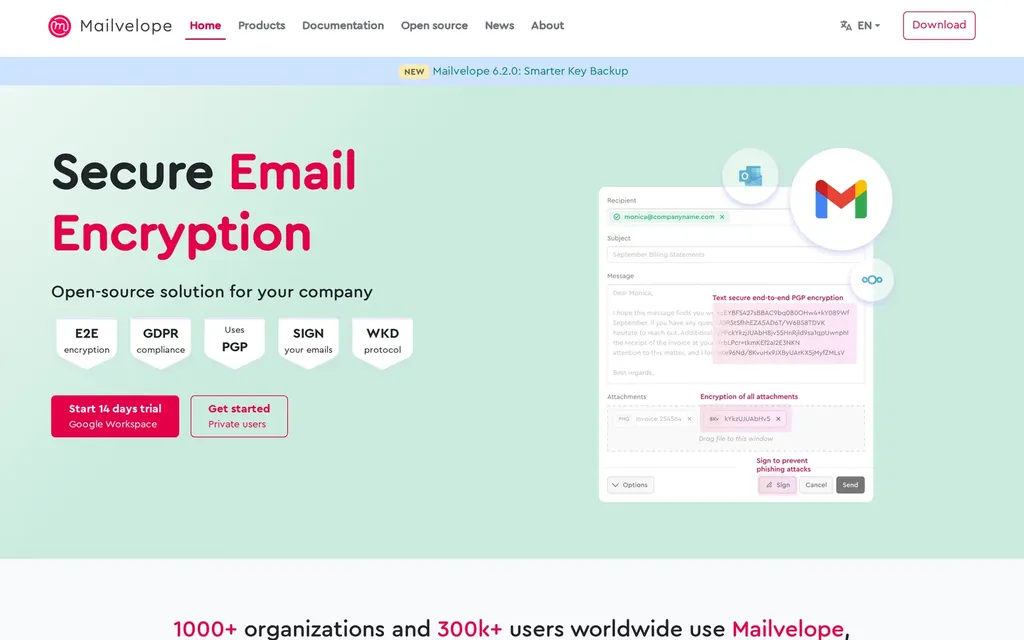
Bring email encryption straight into your Browser. We recommend using Firefox for this. It can be used to encrypt and sign electronic messages, including attached files, without the use of a separate, native email client (like Thunderbird) using the OpenPGP standard. List of supported email providers.

Browser - Mailvelope
Official website mailvelope.com
Our take
Mailvelope bolts OpenPGP onto webmail like Gmail or Outlook straight in the browser, which is its whole appeal and its whole limitation. It only protects message contents, not metadata, and both sides need keys set up, so it is fiddly and only as private as the people you write to. Use it when you are stuck on a mainstream webmail account and need genuine end-to-end encryption for specific messages; do not mistake it for switching to a private provider.
GitHub at a glance
mailvelope/mailvelope
Stars
1,829
+ 5 this week
Last commit
7d ago
healthy
License
AGPL-3.0
Latest release
v6.3.0
8d ago
Stars, last 10d
Listed in
Browser - Mailvelope alternatives

StartMail First choice for privacy email accounts. Users can choose between their web client or third party desktop clients like Thunderbird. Unlimited aliases with the StartMail and…

ProtonMail Free and paid plans include all security features, including end-to-end encryption, zero-access encryption, anti-phishing, anti-spam and 2FA. Own Android, iOS Apps and web…

Tuta Tuta: Free, Cross-Platform and Zero-Knowledge Calendar

SimpleLogin Emails are forwarded to your real email address. If you reply to a sender it will use your alias, too. It is designed to be user friendly and available on many platforms. Based…

addy.io addy.io is an open-source email aliasing service that lets you create unlimited aliases forwarding to your real inbox. Available on web, browser extensions for all major browsers, and Android/iOS apps. Self-hostable. Based in the United Kingdom.

mailbox.org Paid plans enable custom domains. Users can choose between their web client or third party desktop clients like Thunderbird. Based in Germany, founded in 2014.
Browser - Mailvelope license, in plain English
AGPL-3.0 Strong copyleft · network
Free to use, even commercially. Changes must be published under the same license, and running a modified version as a network service counts as distributing it.
Permits
- Commercial use
- Modification
- Distribution
- Patent use
- Private use
Requires
- Disclose source
- Network use is distribution
- Same license
- State changes
- License and copyright notice
Does not provide
- Liability cover
- Warranty
Why it matters: The network clause is the point. Anyone who runs a modified version as a hosted service has to publish those changes, so the code handling your data stays inspectable. This is why privacy-first projects reach for AGPL.
Plain-language summary of the project's license, not legal advice. Read the full text for the exact terms.