Briar doesn’t rely on a central server - messages are synchronized directly between the users’ devices via Bluetooth or Wi-Fi. Online sync via the Tor network is possible, too. Protecting users from surveillance.

Briar
Official website briarproject.org
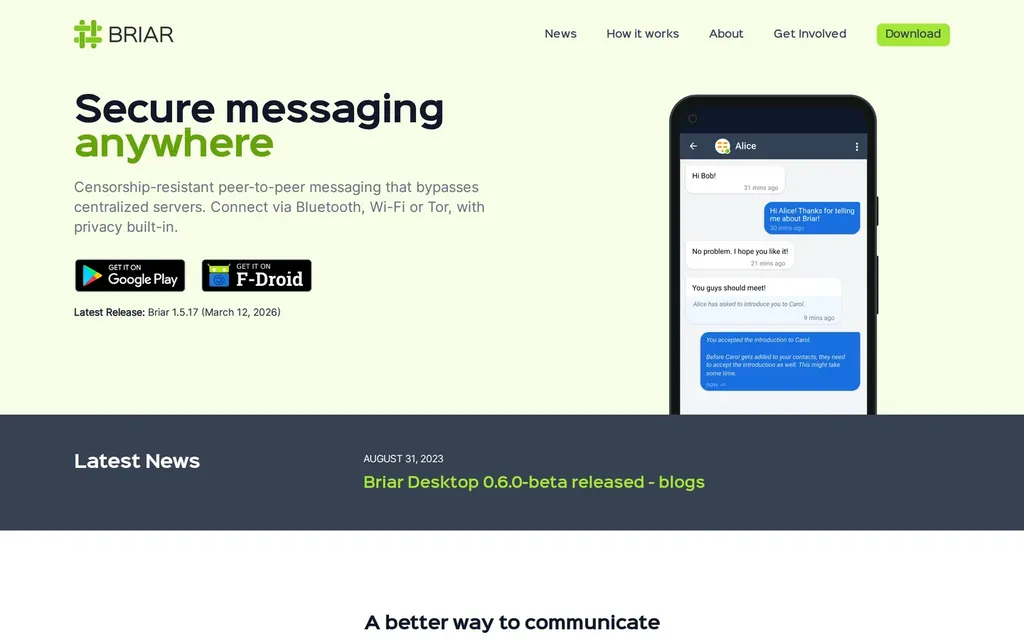
Our take
Syncing directly between devices over Bluetooth or Wi-Fi, with Tor as an option when online, makes Briar the one messenger that keeps working when the network is cut. That same design makes it impractical for everyday distant chat, since both people often need to be present or reachable in awkward ways. Indispensable for activists and anyone planning for blackouts; not your default app for texting friends across town.
GitHub at a glance
briar/briar
Stars
640
+ 7 this week
Last commit
3d ago
healthy
Stars, last 10d
Listed in
Briar alternatives

Signal Similar look and feel of WhatsApp and other commonly used messaging apps, makes switching easy. Signal requires your phone number as an personal identifier.

SimpleX Chat Decentralized messenger that assigns no identifier to users, not even a random number. Contacts are established via one-time invite links or QR codes, with all data stored on-device only.

Session No phone number or email address is required to signup. Similar functionality like Element, but still in an earlier stage of development. Decentralized servers routed through…

Status No phone number or email address is required to signup. Uses the peer-to-peer (p2p) messaging protocol Waku that removes centralized third parties from messages.
Threema No native desktop apps available yet, but there is a web version for your browser. No phone number is required to signup but there is a payment involved to get the app.…

Molly Hardened fork of Signal for Android that adds an encrypted local database, automatic RAM wiping on lock, and Tor/SOCKS proxy support via Orbot. Ships in two variants: one with FCM push and one fully FOSS without Google.